Partial point cloud
PointNet-style layers encode the incomplete geometry into a global representation.
points → geometric codeTOPO-PCN / 3D DEEP LEARNING
Complete the shape.
Keep the hole.
Reconstruct 3D geometry. Preserve structure.PyTorch / GUDHI · Learned topology fusion.
DRAG TO ROTATE · SCROLL TO ZOOM · ARROW KEYS
Explore paired benchmark inputs and complete targets.
Interactive data could not load. The original project figures remain available below.
01 / WHY TOPOLOGY
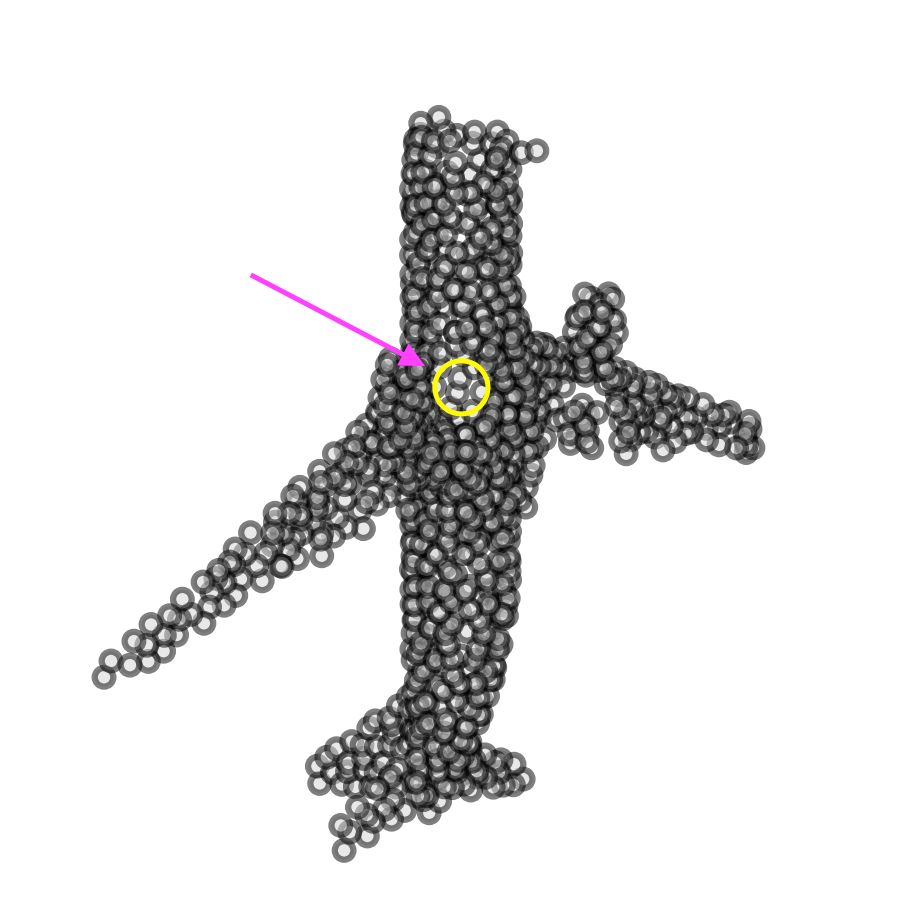
Geometric closeness alone does not tell the whole story. Controlled holes make structural errors visible, creating a testbed for completion models that need to preserve more than the surface.
02 / THE APPROACH
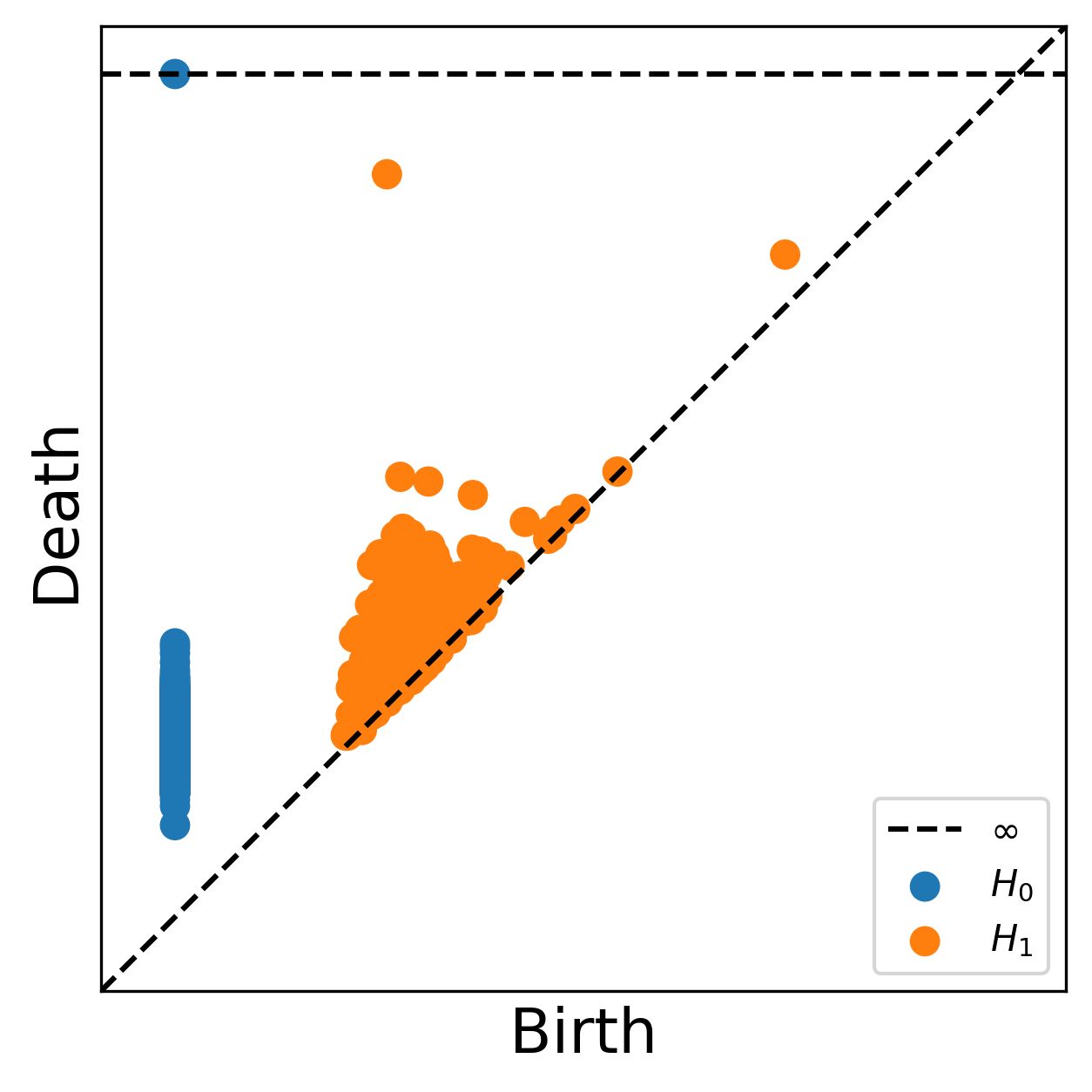
Topo-PCN adds a small learned topology branch to a PCN-style network. The decoder receives geometric features together with a descriptor of the input’s persistent structure.
PointNet-style layers encode the incomplete geometry into a global representation.
points → geometric codeA three-value persistent-homology descriptor passes through a learned projection.
3 values → 32 featuresConcatenate both representations, then reconstruct a coarse-to-fine point cloud.
joint code → completed points03 / RESULTS
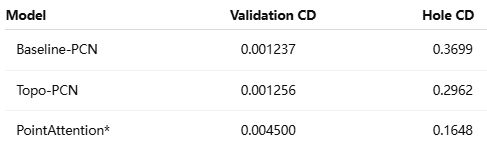
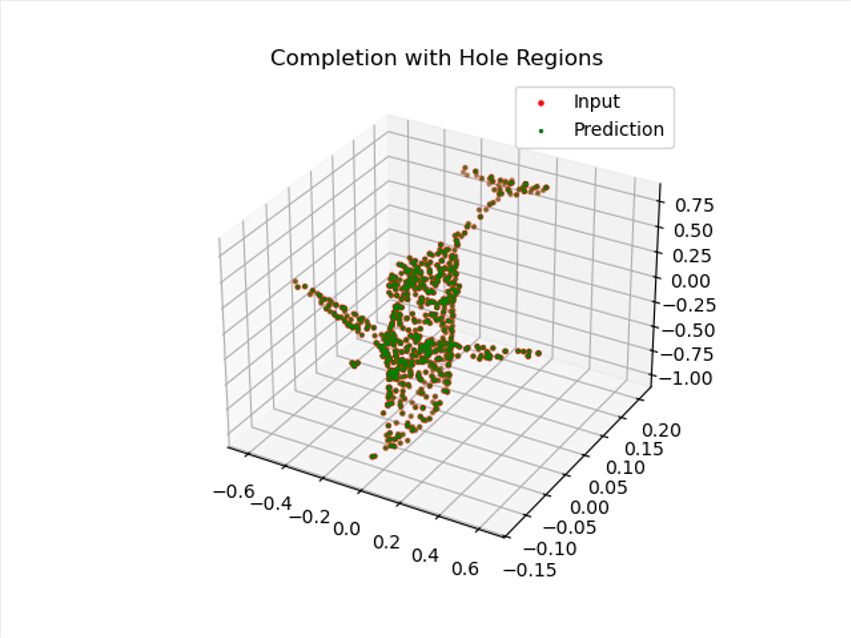
In the presentation’s airplane experiment, Topo-PCN reduces hole-region error relative to the PCN-style baseline, with a small increase in global Chamfer distance.
lower Hole CD
| Model | Validation CD ↓ | Hole CD ↓ |
|---|---|---|
| Baseline-PCN | 0.001237 | 0.3699 |
| Topo-PCN OURS | 0.001256 | 0.2962 |
| PointAttention | 0.004500 | 0.1648 |
Compare global Chamfer distance and local hole-region error across three completion models.
View the original results table ↗Airplane experiment · 80/20 split · Adam · learning rate 10⁻⁴ · 20 epochs.
CODE / DATA