ASME · JMSE 2026Journal of Manufacturing Science and Engineering
Structure-Aligned
Geometric Compensation
for Additive Manufacturing Warpage via Vibrational Modal Analysis
Let structure lead the correction.
Iowa State University
1 Industrial & Manufacturing Systems Engineering 2 Aerospace Engineering 3 Mechanical Engineering
* Corresponding author
01 The insight
Compensation starts
with representation.
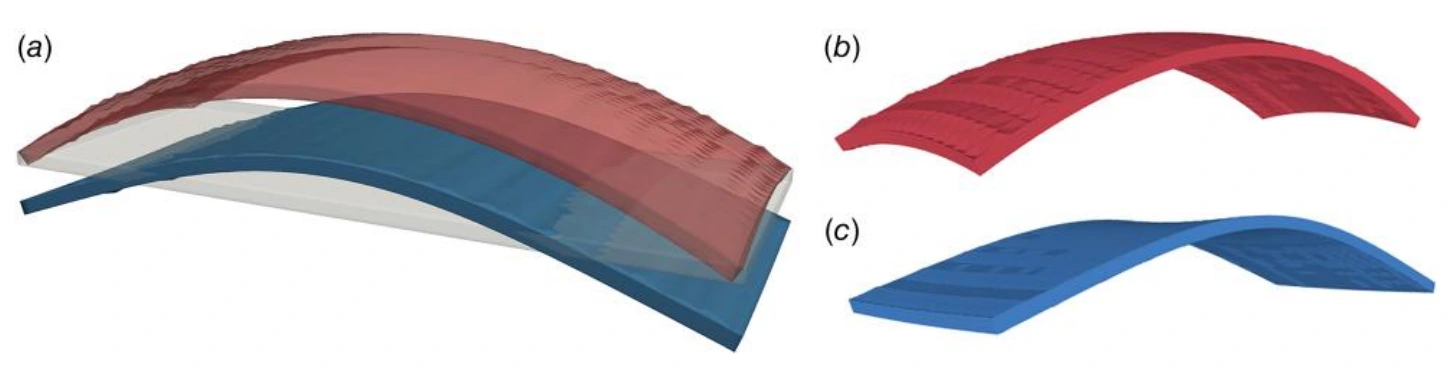
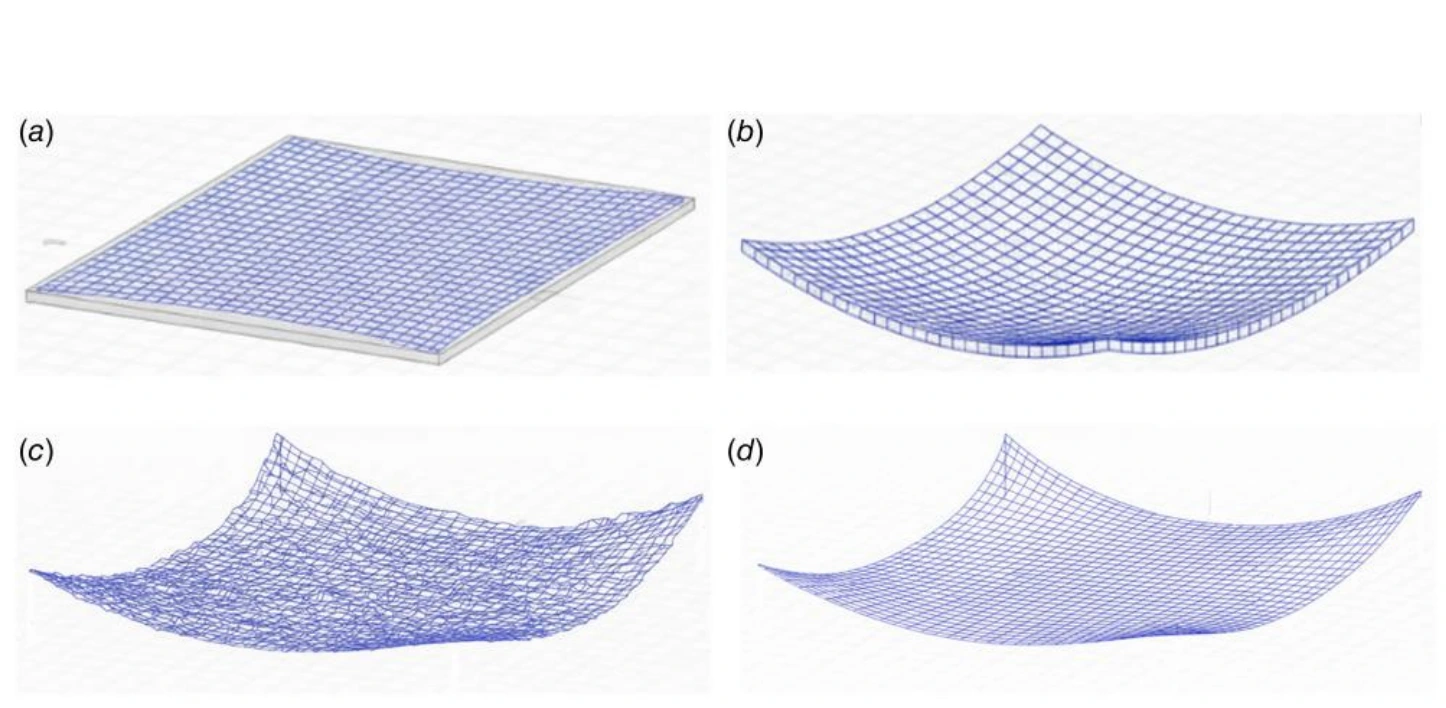
Measured deformation contains both structural warpage and local artifacts. We project it onto a small set of the part’s vibration modes, then reverse only the retained structural component.
- Geometry
- Modes
- Projection
- Compensation
02 The evidence
Less residual warpage.
Smoother correction.
Finite-element studies on a plate and an L-bracket show lower residual deformation than direct inversion.
Lower residual RMS
0.014 → 0.0061 mm
Direct inversion → Modal · Table 3
Lower peak residual
2.94 → 2.07 mm
Direct inversion → Modal · Table 4
Rounded reductions relative to direct inversion in the paper’s single-pass finite-element closed-loop studies.
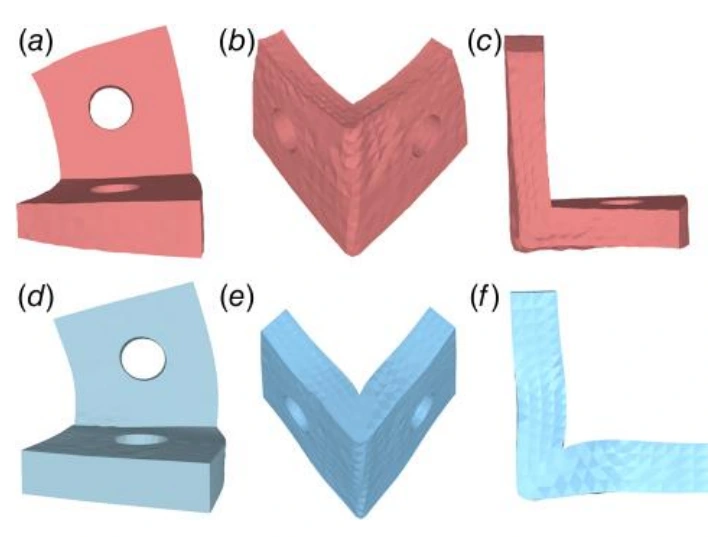
Smoother geometry under imperfect observations.
Modal projection suppresses local reconstruction artifacts while preserving the main structural deformation.
The benefit is strongest when a compact structural modal basis captures the deformation. Improvement varies with geometry.
Continue exploring
Explore the research.
BibTeX
@article{ye2026structure,
  title = {Structure-Aligned Geometric Compensation for Additive Manufacturing Warpage via Vibrational Modal Analysis},
  author = {Ye, Yifei and Liu, Lijie and Liao, Yiliang and Holland, Stephen and Krishnamurthy, Adarsh and Li, Qing},
  journal = {Journal of Manufacturing Science and Engineering},
  volume = {148},
  number = {11},
  pages = {111003},
  year = {2026},
  doi = {10.1115/1.4072276}
}